








Finding the right astrologer is not like searching for a plumber or a dentist. The skills involved are harder to verify, the results are harder to measure, and the quality of a session depends heavily on the fit between practitioner and client. A good astrologer for one person may be entirely wrong for another.
A good astrologer match comes down to three things: their tradition and approach align with how you think, their specializations match what you are trying to explore, and their session reviews describe work that is relevant to your situation. Everything else is secondary.
This guide walks through what to look for, what questions to ask, and how to make a confident, informed decision before you book.
Start With What You Actually Need
Before looking at any astrologer’s credentials or reviews, clarify what kind of session you are looking for. Astrology covers a wide range of purposes, and practitioners often specialize.
Reading types include:
- Natal / birth chart readings: an interpretation of who you are and the patterns in your life based on your birth data
- Forecast / timing readings: what is coming up and when, using transits, progressions, or solar returns
- Relationship / synastry readings: compatibility and dynamics between two people
- Career and life purpose readings: vocational astrology and decision support
- Spiritual and karmic readings: soul growth, past life themes, evolutionary purpose
- Wellbeing readings: the intersection of health, body, and planetary cycles
- Horary: answering a specific question using the chart cast at the moment of asking
- Electional: choosing the best time to start something
- Relocation / astrocartography: finding places that support your goals
- Rectification: working backwards to determine an unknown birth time
Knowing which type of session you need narrows your search significantly and helps you avoid booking with an astrologer who does not do that kind of work.
Understand the Different Approaches and Traditions
Astrology is not a single system. It is a family of traditions with meaningfully different methods, symbols, and philosophies. The tradition an astrologer works in affects everything from how they interpret your chart to what questions they consider answerable.
The main traditions include:
- Western astrology: the most widely practiced system in Europe and North America, using tropical zodiac signs and a range of modern interpretive methods
- Vedic / Jyotish: the Indian system, using the sidereal zodiac and dashas (planetary period systems), often with a focus on timing and karma
- Hellenistic: the ancient Greek roots of Western astrology, increasingly revived and valued for its precision and classical techniques
- Traditional: medieval and Renaissance astrology, with strict dignity systems and predictive emphasis
- Psychological astrology: synthesizes astrological symbols with depth psychology, focusing on self-understanding rather than prediction
- Evolutionary astrology: emphasizes soul growth and karmic patterns across lifetimes
- Chinese astrology: an entirely separate system including BaZi (Four Pillars of Destiny) and other methods, with its own cosmology and interpretive logic
An astrologer who works in the Hellenistic tradition will approach your chart very differently from one working in a psychological framework. Neither is wrong. But knowing which approach resonates with you, or which you want to explore, helps you find someone whose work will actually speak to you.

Look Beyond Name and Price
Most people searching for an astrologer encounter the same limited information: a name, a photo, a location, and sometimes a price. That is rarely enough to make a good choice.
What actually tells you whether an astrologer is worth your time and money:
Specializations (strengths): What specific areas does this astrologer focus on? Relationship patterns, career transitions, timing of major life events, identity and psychological depth, spiritual themes — these are different skills, and most practitioners are stronger in some areas than others.
Session formats: Does the astrologer work in person, by video, by phone, through written reports, or by email? Some people absorb this kind of information better in a particular format. Some topics are better explored in a live conversation.
Languages: If English is not your first language, working in your native language can make a significant difference in how much you actually get from a session.
Experience and background: Years of practice matters, but so does the quality of training. Look for astrologers who can name their training, their teachers or mentors, and any formal education they have pursued.
Certifications: Several astrological organizations offer recognized certifications, including NCGR (National Council for Geocosmic Research), OPA (Organization for Professional Astrology), ISAR (International Society for Astrological Research), and others. A certification does not guarantee quality, but it signals that the astrologer has submitted their work to external review.
Published work: Books, articles, podcast appearances, and other publications indicate that an astrologer has developed ideas substantial enough to share publicly. This is not required for quality practice, but it is a useful signal of seriousness and intellectual depth.
Astrological school affiliation: Some astrologers have trained within specific schools or lineages — the Kepler College program, the Faculty of Astrological Studies, or specific mentors whose approach shaped their work. This context can tell you a lot about their interpretive style.
How to Search Effectively
A general web search for “astrologer near me” returns whoever has the best SEO, not whoever is the best astrologer. To search more intelligently, you need to be able to filter by the criteria that actually matter.
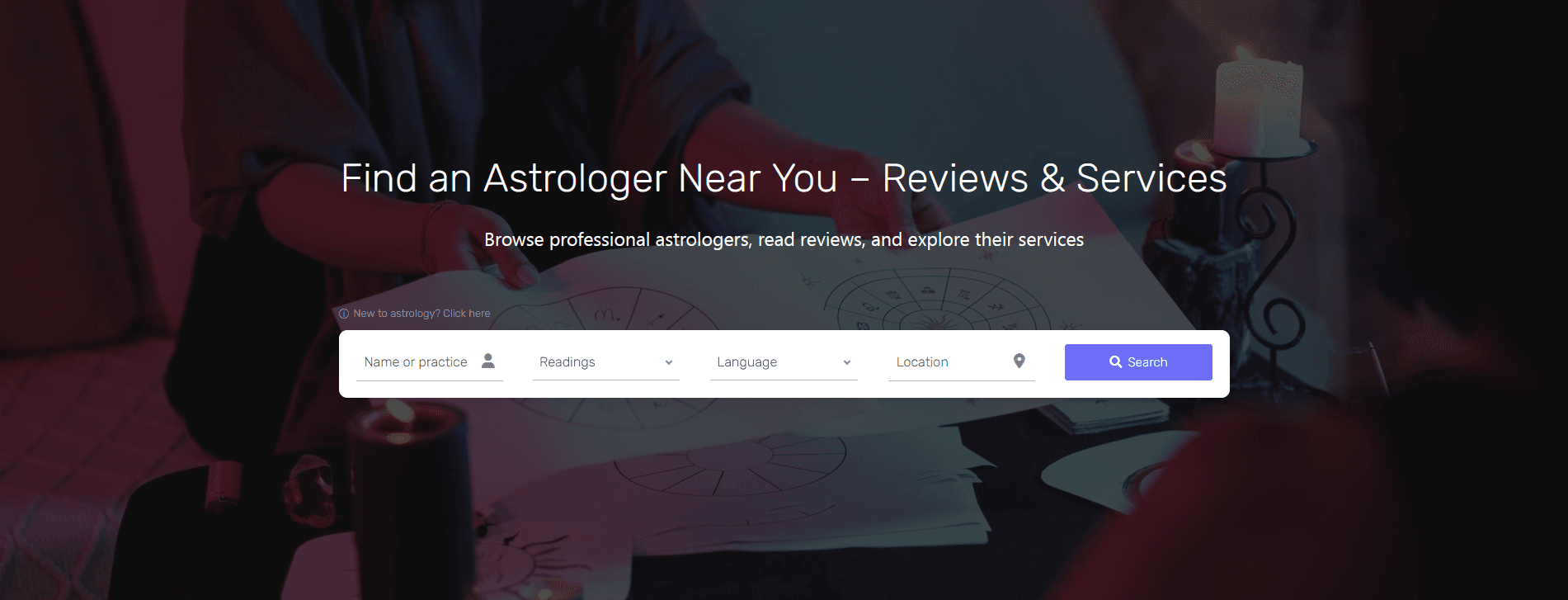
Astrodune is an astrologer directory built specifically for this kind of search. Each profile contains structured information about the astrologer’s reading types, astrological tradition, specializations, session formats, certifications, published work, school affiliations, languages, and even more. You can filter by any combination of these criteria and search by location.
For example: if you are looking for a Vedic astrologer who specializes in career readings, works by video, and has published writing you can read before booking, you can search for that directly. If you want someone working in the Hellenistic tradition with a focus on timing and a formal certification, you can search for that too.
This is different from a generic business directory. The filters reflect how astrology actually works, not how directories usually categorize service providers.
You can also contact an astrologer directly through Astrodune before committing to a session. This is often worth doing. A brief message explaining what you are hoping to explore can tell you quickly whether the astrologer’s approach is a good match for your situation.

Read Reviews That Are Actually About Astrology
Generic star ratings tell you almost nothing useful. A five-star rating on a general review platform might mean the astrologer was friendly and the session ran on time. It does not tell you whether the astrology was any good.
Astrodune reviews are structured specifically for astrology sessions. Each review includes:
- The session focus — what type of reading the client received
- The session format — how the session was delivered
- Whether it was the client’s first session with this astrologer
- Ratings across specific dimensions: overall quality, communication clarity, preparation, interpretation depth, and practical value
- A concrete example from the session — a specific placement, transit, or technique the astrologer used, and how they interpreted it
- What the client actually took away from the session
- Whether the client would recommend this astrologer to others, and for what kind of situation
This structure means that when you read a review on Astrodune, you learn something real. You find out how the astrologer actually works in a session, not just whether the client left feeling good. You see a specific example of their interpretive skill. You understand what situations they are well suited for.
Reviews on Astrodune are submitted only by authenticated users, and each review describes a genuine session experience. This is different from platforms where anyone can leave a rating without any connection to the service.
Questions to Ask Before You Book
Even with good information available, a brief conversation before booking is often worthwhile. Useful questions:
- What kind of preparation do you do before a session?
- What information do you need from me beforehand?
- How do you approach [the specific area you want to explore]?
- What can I realistically expect to take away from this session?
- Do you record sessions, or will you provide notes?
An astrologer who answers these questions clearly and specifically is giving you useful signal about their working style. Vague or evasive answers are worth paying attention to.
A Note on Compatibility
The best astrologer in the world may not be the right astrologer for you. Astrology is a practice built on symbolic interpretation, and interpretation involves a relationship between the practitioner and the client.
Some people want directness. Others want a more exploratory, open-ended approach. Some want practical guidance on decisions. Others want to understand themselves more deeply without being told what to do. These are different things, and different astrologers do them differently.
Reading reviews, looking at what an astrologer has written or said publicly, and sending a message before booking all help you assess fit before you commit. The right astrologer for your situation is the one whose approach, experience, and focus align with what you are actually looking to explore.
Astrodune is a directory of professional astrologers with verified session reviews, structured profiles, and direct messaging. You can search by reading type, tradition, specialization, language, session format, certifications, and location at astrodune.com/astrologers/.