








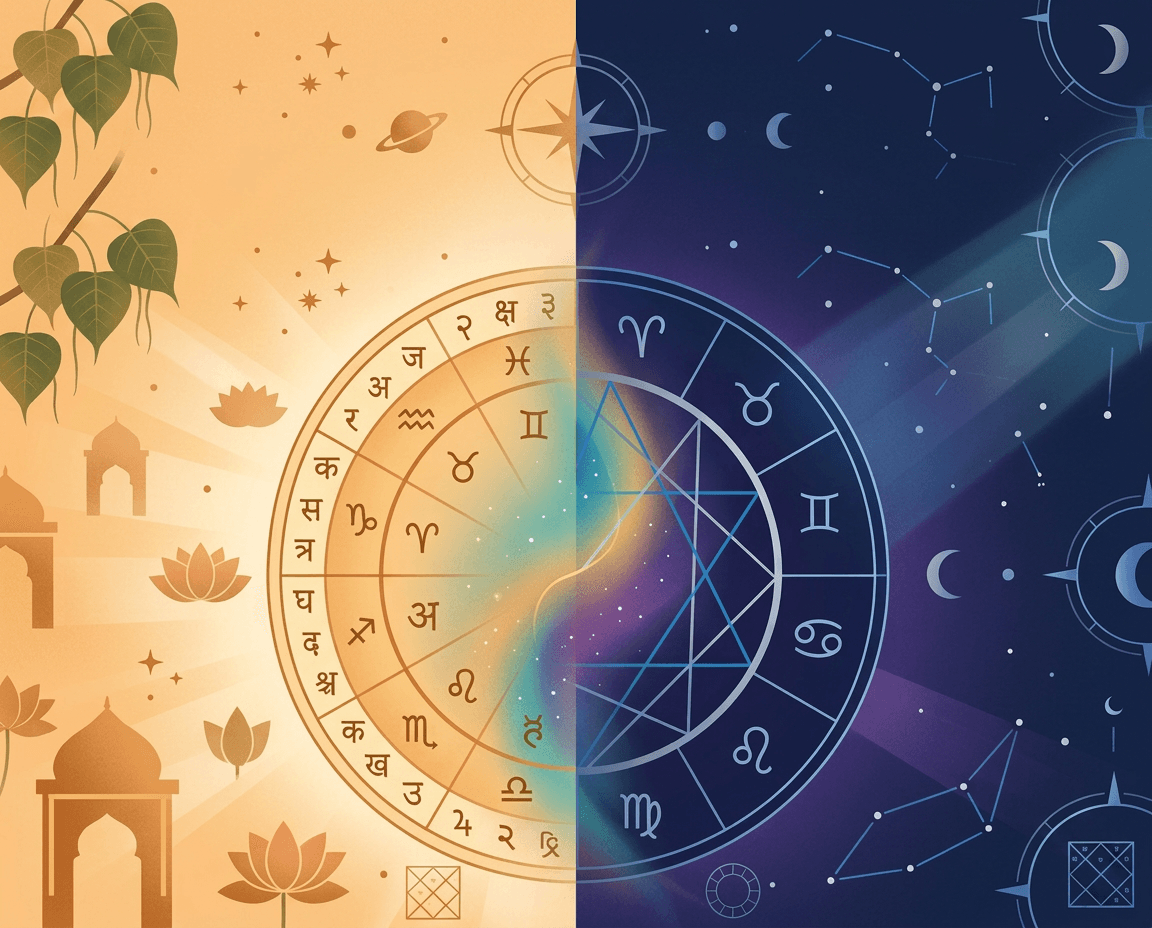
Short answer: Choose a Western astrologer if you want self-understanding, psychological insight, and a framework for personal growth. Choose a Vedic (Jyotish) astrologer if you want concrete, timing-based guidance on practical questions like career, finances, and health. The two traditions use different zodiacs and answer different questions, so the “right” one depends on what you’re actually trying to learn.
Across the 402 astrologers listed on Astrodune, 89% work in a Western tradition and 17.5% work in the Vedic tradition (some practise both, which is why these figures overlap). The rest of this guide explains the real differences, backed by data from the astrologers who practice each tradition, and helps you decide.
The one technical difference that matters: tropical vs sidereal
Western and Vedic astrology are built on two different zodiacs.
Western astrology uses the tropical zodiac, which is anchored to the seasons. The Sun enters Aries at the spring equinox, every year, by definition.
Vedic astrology uses the sidereal zodiac, which is anchored to the actual positions of the constellations. Because Earth wobbles slowly on its axis (a motion called the precession of the equinoxes), the two zodiacs have drifted roughly 24 degrees apart over the centuries.
The practical consequence: your Sun sign is often different in the two systems. Many people who are Leos in Western astrology are Cancers in Vedic. This is not an error in either system; it reflects two different reference points. Neither is “wrong,” but they will describe your chart differently.
This section reflects general astrological convention, not Astrodune data.
“Western astrology” is not one thing
Before comparing the two, it’s worth clearing up a common oversimplification: Western astrology is not a single method. It’s a family of approaches.
Among the Western-tradition astrologers listed on Astrodune, the sub-styles break down like this:
| Sub-tradition within Western | Share of Western astrologers |
|---|---|
| Modern Western (general) | 95% |
| Psychological | 47% |
| Traditional | 23% |
| Evolutionary | 18% |
| Hellenistic | 10% |
| Uranian | 3% |
Most astrologers combine several of these. A “Western” reading from a psychological astrologer and a “Western” reading from a traditional or Hellenistic astrologer can feel quite different. Vedic astrology, by contrast, is more internally consistent as a system.
So the real choice is rarely “Vedic or Western.” It’s “which practitioner, working in which style, for which question.”
Source: the Western-tradition astrologers (roughly 370 profiles) in the Astrodune astrologer directory, July 2026.
Vedic vs Western at a glance
| Western | Vedic (Jyotish) | |
|---|---|---|
| Zodiac | Tropical (season-based) | Sidereal (constellation-based) |
| Origin | Ancient Greece / Babylon, modern Europe & US | Indian subcontinent |
| Typical emphasis | Psychology, self-understanding, growth | Prediction, timing, practical outcomes |
| Signature tools | Transits, progressions, aspects | Dashas (planetary periods), nakshatras, remedies |
| Common reading types | Natal, forecast, relationship | Natal, forecast, career & timing |
| Question it answers best | “Who am I and why do I do this?” | “What is coming, and when?” |
How the two traditions actually differ in practice
This is where directory data reveals something you won’t find on other explainer sites. We compared what Vedic astrologers and Western astrologers on Astrodune actually offer. The pattern lines up almost perfectly with the philosophical difference between the two traditions, and it’s measurable.
Vedic astrologers skew toward concrete, outcome-oriented work. Among the specialties and reading types they offer:
| Focus area | Vedic astrologers | Western astrologers |
|---|---|---|
| Financial | 55% | 16% |
| Career | 74% | 43% |
| Medical / health | 36% | 13% |
| Health readings | 45% | 11% |
| Chart rectification | 23% | 11% |
Western astrologers skew toward inner, psychological work. The same comparison in the other direction:
| Focus area | Western astrologers | Vedic astrologers |
|---|---|---|
| Psychological | 59% | 15% |
| Identity | 69% | 33% |
| Life transitions | 49% | 22% |
| Shadow work | 13% | 3% |
| Mythological | 13% | 1% |
Some things are near-universal in both traditions. Natal (birth chart) readings are offered by 97–99% of astrologers in either camp, and forecasting is offered by roughly 93% in both. The traditions diverge not on whether they read your chart, but on what they use it for.
The plain-language summary: if you ask a Vedic astrologer about your year ahead, you’re more likely to get specifics about career moves, financial timing, and health, often with suggested remedies. If you ask a Western astrologer, you’re more likely to get a psychological narrative about who you’re becoming and what a transit means for your inner life.
There’s a geographic pattern too. Vedic astrologers on the platform are concentrated in India (about 53%) and the United States, while Western astrologers are concentrated in the US, UK, and Australia. This reflects each tradition’s cultural home.
Source: Astrodune astrologer directory, July 2026, comparing roughly 70 Vedic-practising and 340 Western-only profiles. Astrologers can list multiple specialties, so percentages describe how common each focus is within each group, not a share of a single total.
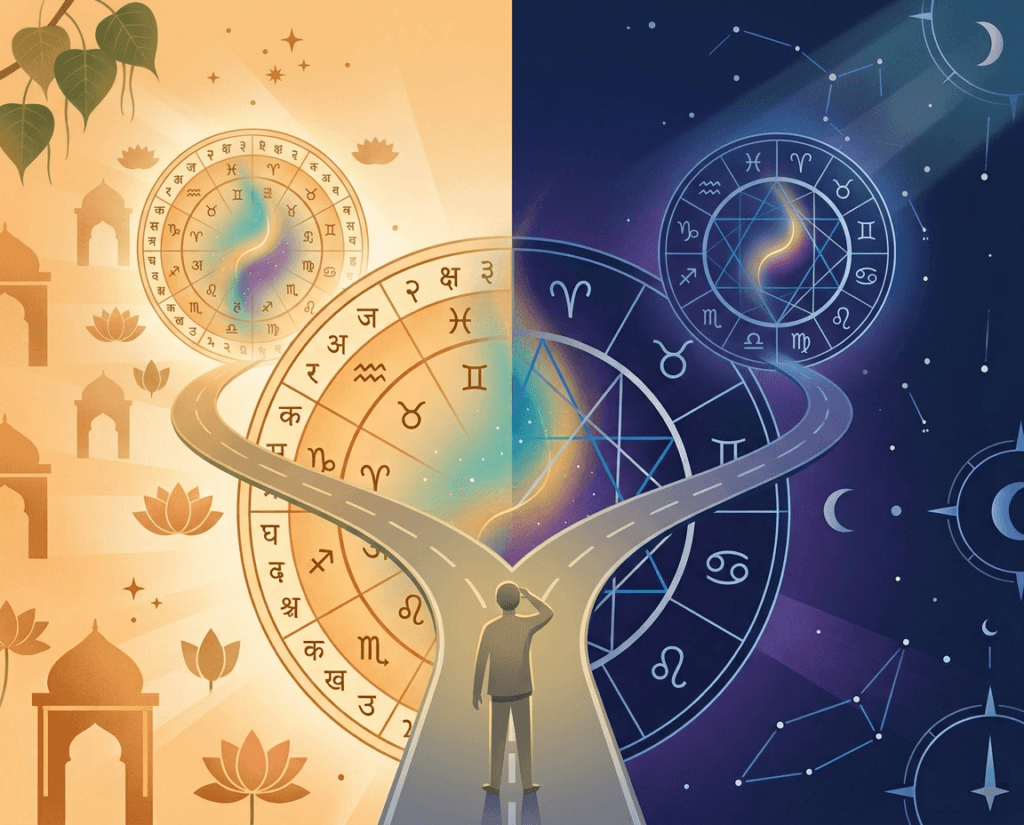
Choose a Western astrologer if…
- You want to understand your personality, patterns, and motivations
- You’re navigating a personal transition and want meaning, not just prediction
- You’re drawn to psychology, archetypes, or personal growth work
- You want to explore identity, relationships, or your inner life
- The why matters to you more than the when
Browse Western astrologers on Astrodune →
Choose a Vedic astrologer if…
- You have a specific practical question about career, finances, or health
- You want timing: when to act, when to wait, what period you’re entering
- You’re open to remedial suggestions (gemstones, mantras, rituals)
- You want concrete predictions more than psychological interpretation
- The when and what to do matter to you more than the why
Browse Vedic astrologers on Astrodune →
Which one is more accurate?
Neither tradition is objectively more accurate, because they measure success differently.
Western astrology’s “accuracy” is usually judged by resonance: does the reading describe your inner experience in a way that feels true and useful? Vedic astrology’s accuracy is more often judged by prediction: did the forecasted event or timing play out?
Because they’re answering different kinds of questions, comparing their accuracy head-to-head is a bit like asking whether a therapist or a financial planner is “more accurate.” The better question is which one fits what you need right now. A skilled, experienced practitioner in either tradition will serve you far better than a mediocre one in the “right” tradition, which is why the individual astrologer matters more than the label.
Do you have to pick just one?
No. Many people consult both traditions for different questions, and a fair number of astrologers practice both. On Astrodune, 28 listed astrologers offer both Vedic and Western readings, so you can even get both perspectives from a single practitioner if you prefer continuity.
A common approach: use Western astrology for ongoing self-understanding and personal growth, and consult a Vedic astrologer when you have a specific, timing-sensitive decision to make.
Frequently asked questions
Is my Sun sign different in Vedic astrology? Often, yes. Because Vedic astrology uses the sidereal zodiac, your Sun sign shifts by roughly one sign for many people. A Western Leo is frequently a Vedic Cancer. Both are correct within their own system.
Which is older, Vedic or Western astrology? Both have ancient roots. Vedic astrology traces to the Indian subcontinent and its classical texts, while Western astrology descends from Babylonian and Hellenistic Greek traditions. Neither is a modern invention.
Can Vedic and Western readings contradict each other? They can emphasise different things, but they rarely “contradict” in a strict sense because they’re describing your chart through different lenses. Think of them as two languages describing the same territory.
Which should a beginner start with? If you’re curious about yourself and open-ended personal insight, Western astrology is an approachable entry point. If you have a specific practical question and want a clear, timing-based answer, start with Vedic. There’s no wrong first step.
Find the right astrologer for your question
The tradition is only half the decision. The other half is finding a practitioner whose focus, style, and track record fit what you’re looking for.
Browse verified Western astrologers and Vedic astrologers on Astrodune, or explore the full astrologer directory. Each profile shows the astrologer’s tradition, specialties, and reviews from real clients, so you can choose based on the questions you actually want answered.
Data in this article is drawn from the Astrodune astrologer directory as of July 2026 (402 listed astrologers). Figures describe the astrologers who practice each tradition on the platform and are provided as a primary-source snapshot of the field.
Want a unique way to learn astrology? Try our astrology social network, where you can explore other members by their birth chart placements and gain new insights.